2026-08-04T14:10:06.593Z ·
Heat Pump vs Furnace: Which Works in Central Illinois Winters?
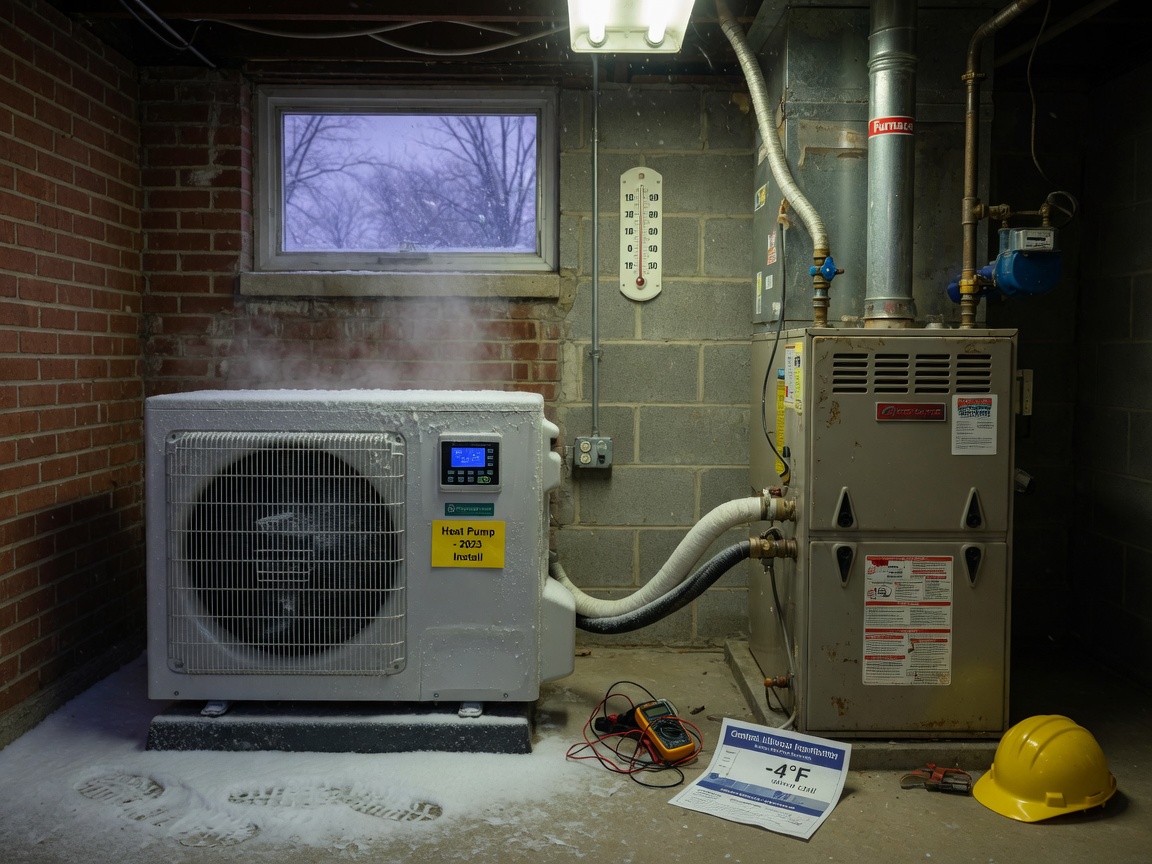
For most Springfield homes, the best answer is not one or the other but both: a dual-fuel system pairing a heat pump with a gas furnace. The heat pump handles fall, spring and mild winter days, which is where the majority of our heating hours actually sit, and the furnace takes over during hard cold when gas becomes cheaper per unit of heat delivered. Where a home is on propane rather than natural gas, or where a full replacement is not on the table, the calculation shifts, and it is worth understanding why.
The local skepticism about heat pumps has a real basis. Systems sold twenty years ago lost most of their useful capacity once outdoor temperatures dropped below freezing, defaulting to expensive electric resistance backup exactly when heating was needed most. Plenty of Central Illinois homeowners tried one, watched their electric bill in January, and concluded heat pumps do not work here. For that generation of equipment, they were right.
Modern cold-climate heat pumps with variable-speed compressors are a genuinely different product. They hold meaningful capacity well below freezing, with good units still delivering useful output into negative temperatures. The physics has not changed, so output still declines as it gets colder, but the curve is far flatter than it was. This is what makes the conversation worth having in Springfield now when it was not worth having in 2005.
Running cost depends on the ratio between your electric and gas rates, which is why national comparisons are close to useless. In Central Illinois with natural gas service, gas typically remains cheaper per delivered BTU during hard cold, while the heat pump is cheaper during mild and moderate weather because it moves heat rather than generating it, delivering several units of heat per unit of electricity. The crossover point is exactly what a dual-fuel changeover setpoint is configured around.
Propane changes the answer significantly. Propane costs substantially more per BTU than natural gas, which is why rural properties around Auburn, Pawnee, New Berlin and Pleasant Plains often see a much stronger case for a heat pump. For a home currently heating with propane, a cold-climate heat pump can reduce heating cost noticeably even accounting for backup heat during the coldest stretches.
Comfort differs in a way people notice immediately. A gas furnace produces supply air around 120 to 140 degrees in short bursts. A heat pump produces air around 95 to 105 degrees over longer runs. Heat pump air feels cool against your skin even though it is heating the house correctly, and this catches people out constantly during their first winter. The upside is steadier temperatures with fewer swings, which many people prefer once they adjust.
Upfront costs run $6,000 to $12,000 for a heat pump system, $3,500 to $7,500 for a gas furnace, and $9,000 to $15,000 for dual-fuel. The dual-fuel premium buys you the ability to always run whichever fuel is currently cheaper, which is worth most in a climate like ours that spends a lot of time in the moderate band where the heat pump wins, then drops hard for a few weeks where the furnace wins.
The practical recommendation: if you are replacing both halves of your system anyway and you have natural gas, dual-fuel is usually the strongest choice here. If you are on propane, a cold-climate heat pump deserves serious consideration on running cost alone. If only your furnace has failed and your air conditioner is relatively new, replacing the furnace with gas is normally the sensible move, since switching system types mid-life means discarding a working condenser. Our heat pump installation and furnace installation pages set out what each involves.